How Low-Rise Foam Adhesive with Spatter Pattern Application Saves Time on Commercial Roofing Projects
May. 19, 2026

Spatter pattern adhesive application can help improve commercial roofing productivity, expand coverage, and help contractors save time. Learn more about JM QuickFoam® Adhesive.
Commercial roofing contractors are always looking for solutions to do more with less: less downtime, less product waste, fewer application steps, and fewer delays between installation phases. One application method that allows crews to work more efficiently is spatter pattern adhesive application, especially when installing insulation, cover boards, and fleece backed membranes with low-rise foam adhesives. Spatter application can help achieve a uniform pattern across the substrate faster than traditional bead-only methods in certain assemblies and when installed in accordance with JM guidelines.
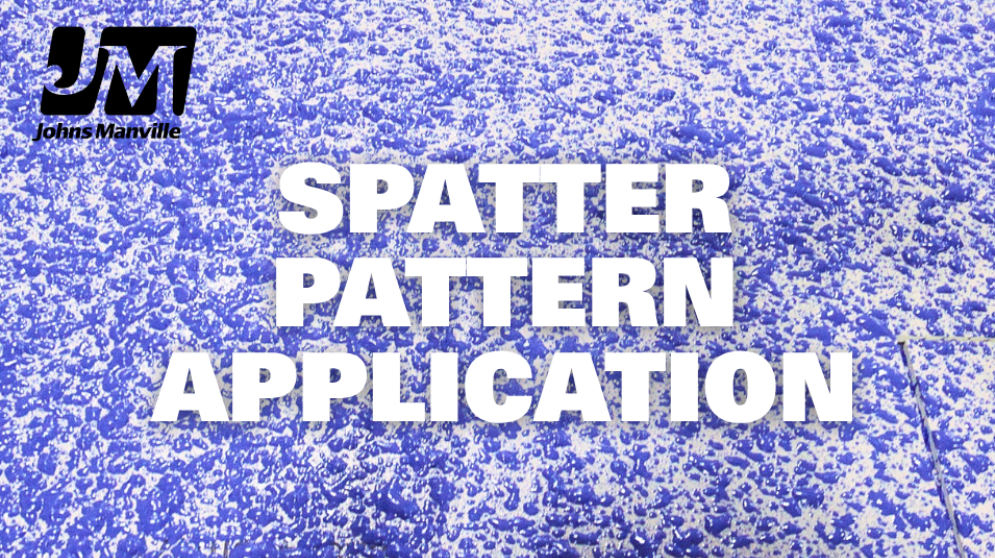
Traditional low-rise foam adhesive is often applied in continuous ribbons or beads. Spatter application uses compatible spray equipment to distribute the adhesive in a broader, more dispersed pattern over the installation area. This helps reduce the time spent laying out individual beads while promoting more consistent adhesive placement when applied in accordance with JM installation guidelines.
For contractors, that difference matters. Spatter application allows crews to more easily transition between board-to-board and membrane installations, utilizing the same application method and equipment across multiple stages of the process. This can lead to improved productivity and reduce transition time.
The biggest benefit of spatter application is simple: efficiency improves by helping crews cover more area while still meeting performance requirements when installed as directed in applicable specifications.
Spatter application distributes adhesive in a broader pattern, enabling faster coverage. This can reduce time spent on adhesive layout, improve workflow, and help contractors move more efficiently across large roof areas. The difference is clear:
JM QuickFoam® can be applied in spatter pattern at rates as low as 0.50 gallons per 100 square feet, compared with 1.1 gallons per 100 square feet when applied in beads spaced 4" on center. For contractors, that can mean better coverage, less material handling, and valuable time savings on the roof.
JM QuickFoam® Adhesive is a two-component, low-rise polyurethane foam adhesive designed for approved fleece backed membranes, insulation, and cover board securement. It can be used in both bead and spatter applications, giving crews flexibility based on the project and assembly requirements.
Built for speed and performance, JM QuickFoam® helps contractors improve productivity while supporting a clean, smooth appearance. Retraction technology minimizes post-rise of the foam. This helps reduce telegraphing as the adhesive cures and allows insulation boards to be walked-in and rolled with a 150 lb. roller within 5–7 minutes from initial application to help maintain contact during cure.
Before applying JM QuickFoam® Adhesive, contractors should confirm that all surfaces are properly prepared. Substrates should be clean, dry, smooth, and free of dirt, debris, oil, grease, gravel, or other contaminants that could affect adhesion. Proper surface prep helps support strong adhesive performance and efficient installation.
Contractors should also verify spray equipment compatibility before starting work. JM QuickFoam® is engineered for broad compatibility and works effectively with all major spray rigs, allowing crews to switch to JM QuickFoam® without significant modifications to their equipment setup in many cases. For specific requirements, contractors should reference the JM QuickFoam® Installation Guidelines for the complete list of compatible spray equipment.
Yes. Spatter application can reduce time compared to applying individual adhesive beads, and help crews move more efficiently between installation stages.
Yes. JM QuickFoam® is designed for attaching fleece backed single ply membranes, insulation boards, and cover boards in approved applications.
Yes. QuickFoam® systems include numerous Very Severe Hail approved assemblies, and systems using JM TPO Fleece Backed Roofing Membrane and JM QuickFoam® may be eligible for enhanced hail protection through JM’s Peak Advantage® Guarantee program.
Spatter pattern application gives contractors a practical way to help to improve roofing productivity, expand adhesive coverage, and reduce time spent switching between installation steps. When using JM QuickFoam® Adhesive, crews can leverage the added benefits of strong green strength, flexibility, minimal ballasting, and efficient coverage, helping them install high-performing commercial roofing systems faster and with confidence.
This article is provided for general informational and educational purposes only and does not constitute engineering, design, or application advice. Performance outcomes may vary based on site conditions, application methods, materials, and other factors beyond Johns Manville’s control. Johns Manville makes no warranties regarding accuracy, completeness, or suitability of information, and results may vary based on conditions beyond its control.