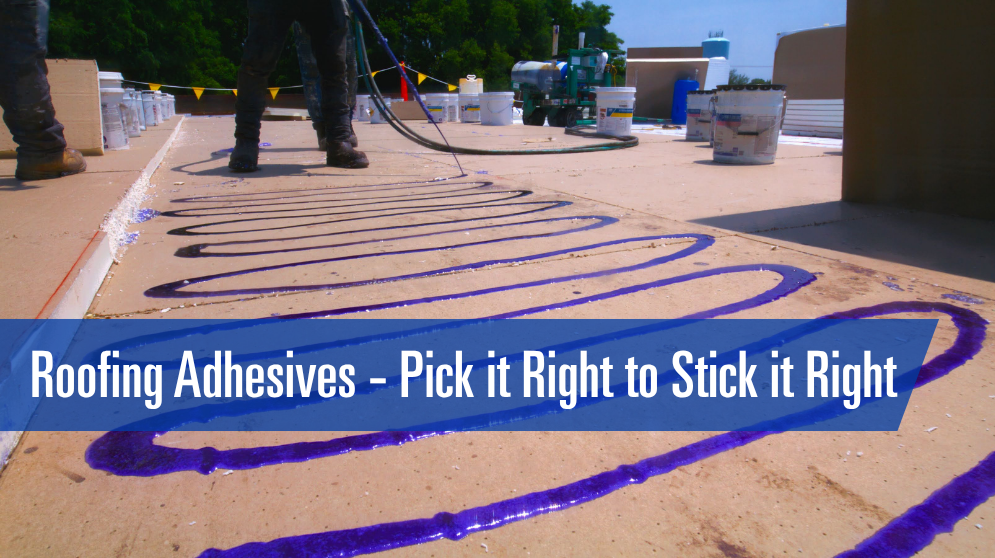
Roofing Adhesives - Pick It Right to Stick It Right
Apr. 09, 2026

One of the key decisions in any commercial roofing project is choosing between a ballasted, mechanically fastened, or adhered system. Each method has advantages and is suited to different building conditions, but adhered systems are often selected for their lighter weight and proven long‑term performance. When an adhered system is chosen, understanding how the membrane is bonded to the substrate becomes critically important.
Selecting the right adhesive ultimately comes down to ensuring the bond between the roofing membrane and substrate is complete, strong, and durable enough to last the life of the roof. Several important factors should be evaluated.
Substrates
The roof deck and substrate material are determined by the architect or engineer for the project based on a variety of building design criteria or the existing conditions of a building that is already built. So, the first thing to check is the compatibility of any adhesive with the roofing components. Is the substrate the structural deck (i.e., concrete, metal, or wood) or is rigid insulation and possibly a cover board included – if so, what type? How are these components secured in place – are they mechanically fastened or is an adhesive being considered? Urethane adhesives can often be utilized to secure multiple components within the roof system.
Pro Tip: Consider the use of a two-part urethane adhesive. These products offer exceptional performance properties, are compatible with a wide variety of substrates, and can be used to secure applicable membranes as well. If a fleece backed membrane is being use, two-part urethane adhesives can be an effective, simple option for securing all layers of the roof system using only one product.
JM QuickFoam® Adhesive is a two-part, urethane foam adhesive for attaching fleece backed single ply membranes to insulation boards, insulation boards to each other, or direct to the deck. It is compatible with a wide variety of substrates and application methods, making it a versatile solution for a high performing roof. This new adhesive helps contractors work faster while delivering enhanced performance and strength.
Roofing Membrane Considerations
The type of roofing membrane—single‑ply or bituminous—directly influences adhesive selection.
For single‑ply membranes such as TPO, PVC, and EPDM, spray‑on or roll‑on solvent‑based adhesives are traditionally used. However, many regions now require low‑VOC or water‑based options, which have become increasingly common. It’s essential to verify regulatory requirements for your project location. Additionally, each adhesive is formulated for specific membrane types. Some adhesives are compatible with both TPO and EPDM, for example, but not with PVC, which requires its own formulation. Consulting with the membrane manufacturer helps ensure correct adhesive selection and system performance.
Pro Tip: Use the equipment or applicators recommended by the adhesive manufacturer. These tools are designed to deliver proper coverage and can improve installation efficiency.
For bituminous membranes—including SBS, ABB, and BUR—the adhesive or mastic selected may be hot‑ or cold‑applied. In these systems, the adhesive is often integral to waterproofing, making compatibility especially important. Not all adhesives from a single manufacturer are appropriate for every bituminous system, so checking technical data is essential.
Pro Tip: For SBS systems, consider adhesives that cure using ambient moisture. These products form elastic solids capable of absorbing movement and stresses within the roof assembly.
JM DynaSet 1K is a high‑performance roofing adhesive formulated to be solvent‑ and odor‑free, making it ideal for installations in occupied spaces such as healthcare facilities or schools. Its moisture‑curing chemistry allows for faster installation on new concrete or in re-roofing conditions with a high humidity substrate. With a quicker cure time than traditional solvent‑based adhesives, DynaSet 1K helps keep projects on schedule while maintaining strong, long‑lasting adhesion.
Hybrid Systems
Hybrid systems—combining a bituminous membrane with a single‑ply cap sheet—have unique compatibility needs. Not all single‑ply products can be installed over bituminous materials, and some cannot tolerate bitumen‑based adhesives. Still, certain combinations work effectively when cold‑applied adhesives are used.
Pro Tip: To ensure full compatibility in hybrid systems, use products from the same manufacturer for all layers of the assembly.
Flashings and Details
A roof’s performance depends on much more than the field membrane. Edge details, penetrations, wall transitions, equipment curbs, and other interruptions must be handled correctly using products designed for each condition. Various adhesives, cements, and sealants are formulated for specific uses, such as pourable sealers for penetration pockets or thermoplastic sealants for detail work with compatible membranes. Some products are intended specifically for vertical surfaces to ensure strong adhesion against gravity and environmental forces.
Pro Tip: Low‑VOC sealants and adhesives offer healthier installation conditions and environmental benefits. While some regions require them, they are increasingly a smart choice nationwide.