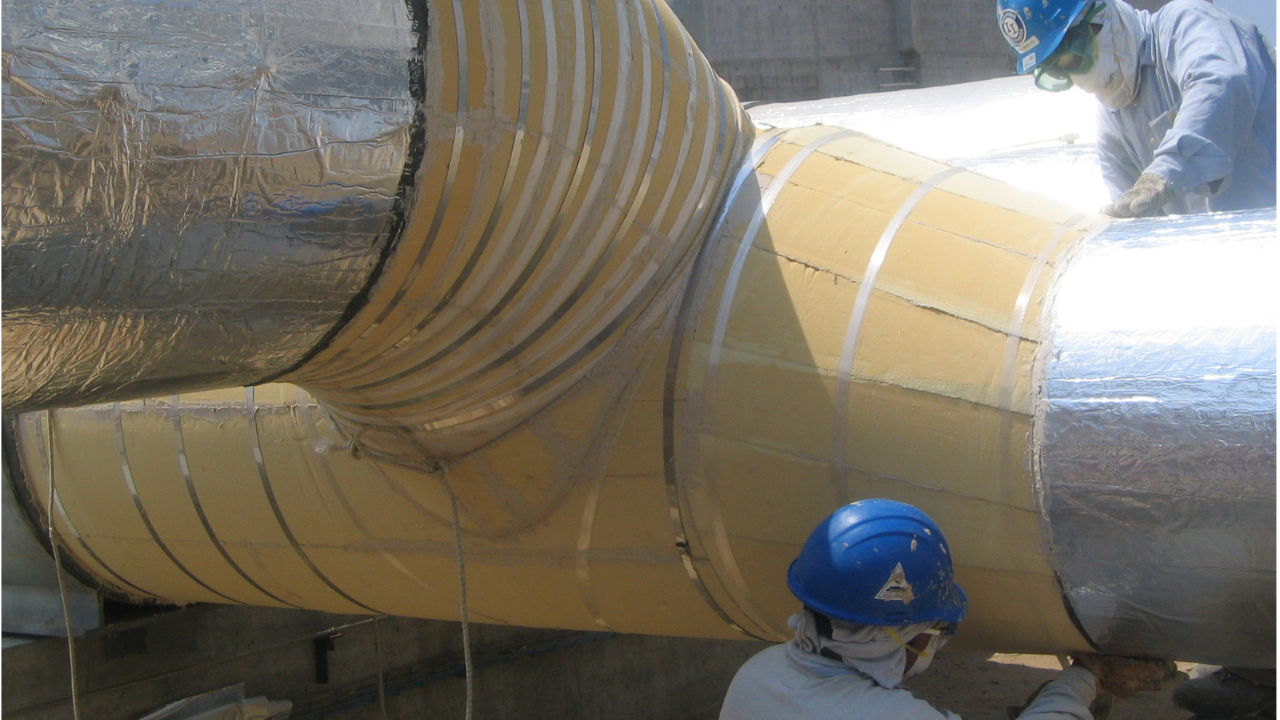
Despite its intimidating name, polyisocyanurate (PIR) is one of the most widely used and versatile insulation materials in industrial and mechanical systems. It is used to insulate pipes, tanks and vessels, as well as HVAC ductwork and ammonia refrigeration systems.
PIR is a behind-the-scenes workhorse, keeping critical infrastructure protected and working efficiently. Johns Manville’s Trymer® PIR product is manufactured as bunstock (a solid foam block) and is very versatile. The bunstock manufacturing process produces blocks large enough to be fabricated into customized components, meeting the exact specifications and tolerances required for any project.
Trymer PIR 101
Trymer is formed by catalytically reacting polyisocyanates with polyols. By varying the ratio of these raw materials, foams with varying properties are produced. It is the PIR specifically which improves the negative attributes usually associated with urethane foams. These include dimensional stability, flame/smoke properties and high temperature stability.
In addition to polyisocyanates and polyols, several auxiliary components are used to produce Trymer, including foaming agents, surfactants and flame retardants. Careful selection and reaction of these raw materials allow Trymer to be “tailor-made” for the specific application.
Johns Manville manufactures Trymer in several densities, ranging from 1.8 pcf to 6.0 pcf, at its plant in La Porte, Texas. Lower density foams are mostly used for applications that require little to no load bearing capabilities, such as straight run pipe. The higher density foams, which have a higher compressive strength, are mostly used for pipe supports or saddles. Currently, JM’s available lengths range from three to 12 feet.
Why PIR insulation
PIR insulation has a lot of beneficial attributes. They include:
- Good thermal efficiency
- Easy to fabricate
- Closed-cell, which means good water resistance (but needs a continuous vapor retarder on the outer surface for any cold pipe or equipment insulation system)
- Low cost per board foot as compared to other insulation materials
- Long service life – depending on the design or specifications and quality of installation, Johns Manville has examples of Trymer PIR lasting 20-30 years in highly demanding LNG pipe insulation applications
- Easy to install• Dimensional stability
- Low flame/smoke resistance
Markets for PIR
Because Trymer is stable from -300°F up to +300°F, it can be used across several markets. Heavy industrial is a top market for PIR insulation. This includes oil, gas and petrochemical applications. PIR is often used in cryogenic applications like liquid nitrogen, liquid natural gas (LNG) and ethylene production.
Low end hot applications up to +300°F are another market for Trymer. This includes things like low pressure steam, heat transfer fluids and heat tracing. It is an excellent insulation for personnel protection at these elevated temperatures.
PIR is also popular in light industrial/refrigeration. Trymer can be used to insulate pipes in ammonia and carbon dioxide refrigeration. These are mostly found in food and beverage manufacturing and storage facilities.
Another key application for Trymer is chilled water piping in commercial buildings. Trymer 2000XP is widely used in non-plenum areas of commercial buildings (outdoors and mechanical rooms), while Trymer 25-50 is used in plenum areas where the required insulation thickness is 1.5” or less.
Trymer is widely becoming a go-to product in data center construction. With the market-wide shortage of fiberglass insulation, many contractors and owners are looking for alternative products so that construction in this rapidly expanding field isn’t slowed down. Trymer is not only used on the straight run pipe, but the higher density foams are used extensively for pipe supports or inserts in data centers.
On the creative side, Trymer PIR has a niche market as a sculpting foam for many applications. The movie industry has used it for years to sculpt shapes for movies such as Batman, Godzilla and the Flintstones. A major theme park routinely carves Trymer into shapes for rides and park entrance props, and because of its unique makeup, it holds up to intricate carving.
Distribution
Once buns (up to 24”x48”x36” in size) are manufactured, the foam is allowed to cure for a set length of time before being shipped to a location in JM’s fabricator network across North America. There, it is cut into whatever size and shape required for the insulation job.
Fabricators then send finished pieces to either distributors or insulation contractors. Distributors and fabricators also have other capabilities. They can add vapor retarders to the fabricated Trymer if required, so that it is ready to use out of the box once it reaches the jobsite. The distributor also supplies other materials needed alongside Trymer for a job such as metal jacketing and accessories, PVC, and joint treatments.
Trymer polyisocyanurate foam is a very specialized insulation product that has been used since the mid-1960s. It continues to be manufactured in the same facility it started in all those years ago. Thanks to its long service life and excellent thermal efficiency, PIR is a great solution for many insulation needs. Trymer bunstock is like a blank slate, sent to fabricators to become whatever shape and size a customer needs. Not only does a customer get excellent foam from Johns Manville, but the technical support and sales teams are also available to assist with any questions a customer might have.