Your best defenses against CUI
Jul. 13, 2026
by Kristen White

The phrase “corrosion under insulation” can be scary, conjuring up thoughts of shutdowns and major repair costs. Wouldn’t it be great if there was a magic fix to stop CUI?
Unfortunately, there is no “silver bullet” when it comes to stopping corrosion under insulation. But, using a combination of strategies, you can greatly reduce the risks. We’ll explore several points that should be considered when it comes to CUI prevention.
A properly designed and installed system
Sounds straightforward enough, right? Making sure that an insulation system is properly designed, and then professionally installed correctly, is the first line of defense to shed water from the outside environment and keep insulation dry.
Material consideration is key to a properly designed and installed system. The three main items to consider are the insulation, vapor retarder and jacketing. Additional material considerations include insulation joint sealant, vapor stops and jacket securement.
Insulation joint staggering and contraction joint design must be considered in the design. Staggering longitudinal and butt joints between layers improves the integrity of the insulation system and helps impede water and vapor entry through joints. Forcing water or moisture through the most torturous pathway within the insulation helps keep it from reaching the metal substrate.
Vapor stops work to limit and isolate any damage caused by water penetration into the insulation system. Typically, these are on either side of valves, flanges and elbows – locations where water ingress may be most likely to occur.
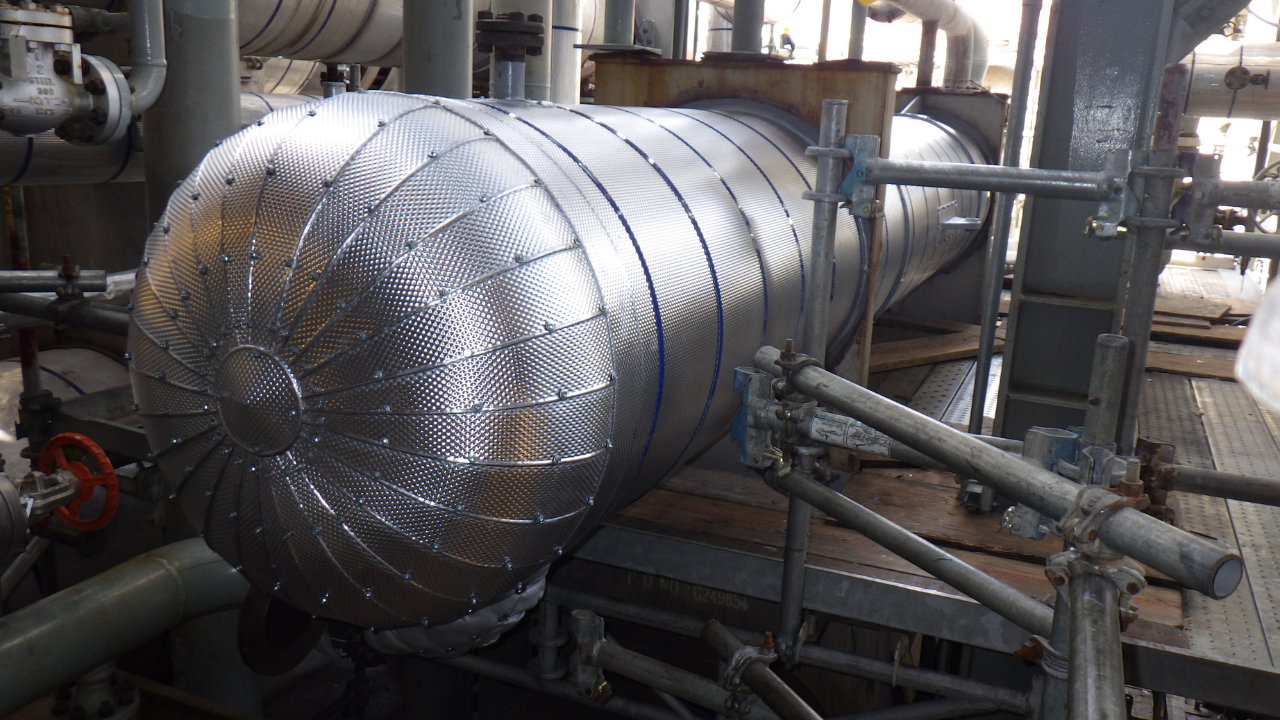
Jacketing is the final material consideration. The type of jacketing is determined based on the location and environment (i.e. indoors or outdoors, corrosive environment or not). Jacketing is an insulation system’s first line of defense in keeping water out of the system, so proper selection is important.
Pipe coatings, hydrophobic/water resistant insulation and corrosion inhibitors
Coating on the metal substrate can be the last thing to protect the piping or equipment from CUI, if everything else fails. If moisture migrated inside the jacketing and made its way through insulation, a coating on the pipe is the only thing left to keep the water from contacting the metal substrate and eventually triggering corrosion.
Using hydrophobic or water-resistant insulation, such as JM’s Thermo-1200 calcium silicate, is another great tactic in the fight against CUI. These types of insulation materials limit the amount of water that can be absorbed and therefore held in contact with bare metal, again lowering the risk of CUI.
Thermo-1200 also includes our XOX Corrosion Inhibitor®, a proprietary corrosion inhibiting formula that helps protect against CUI. Per ASTM C1617 test methods, Thermo-1200 with XOX has one of the lowest corrosion rates of any industrial insulation available. Its inhibitors activate with water and help protect the steel surface from corrosion by forming a silica gel protective coating and buffering pH.
Inspections, repairs and maintenance
A crucial but sometimes overlooked step is checking in on insulation systems after they’ve been installed. Regular maintenance is key to protecting the investment of a high-quality insulation system so it can achieve its expected long lifespan.
Catching a problem earlier is easier, less expensive and often requires no or little downtime to correct, versus a shutdown for major issues.
Inspection frequency depends on ambient conditions, system complexity, system age, system importance and system quality. Things to look for include moisture or ice, particularly at low spots in the system or pipes, holes or breaches in jacketing or vapor retarders, loose jacketing or banding, or caulking failure.
Allow a path for water to exit the system
Unfortunately, many experts agree that some degree of water will enter an insulation system over time, at some point in its lifetime. Since water in contact with bare metal is the primary trigger for CUI, t’s a great idea to facilitate drainage. Weep holes or drainage ports in jacketing give water somewhere to exit.
Even better, jacketing like Johns Manville’s Cross-Flo increases the likelihood of moisture finding its way out of a system. The embossed pattern is engineered to promote cross-directional flow, providing a path for unwanted moisture to more rapidly and thoroughly reach the low point of a system and exit the jacketing through a weep hole or drainage port.
When it comes to CUI prevention, the more tools you use, the better. Including as many defenses as time and cost will allow helps to lower the risk of encountering CUI.
“Do as many things as you can to minimize the opportunity. It’s a ‘belt and suspenders philosophy’ and an insurance plan,” said Scott Sinclair, retired National Specification Manager for JM. “There’s nothing you can do that will absolutely prevent CUI from happening, so all you can do is try to reduce the risk as much as possible.”