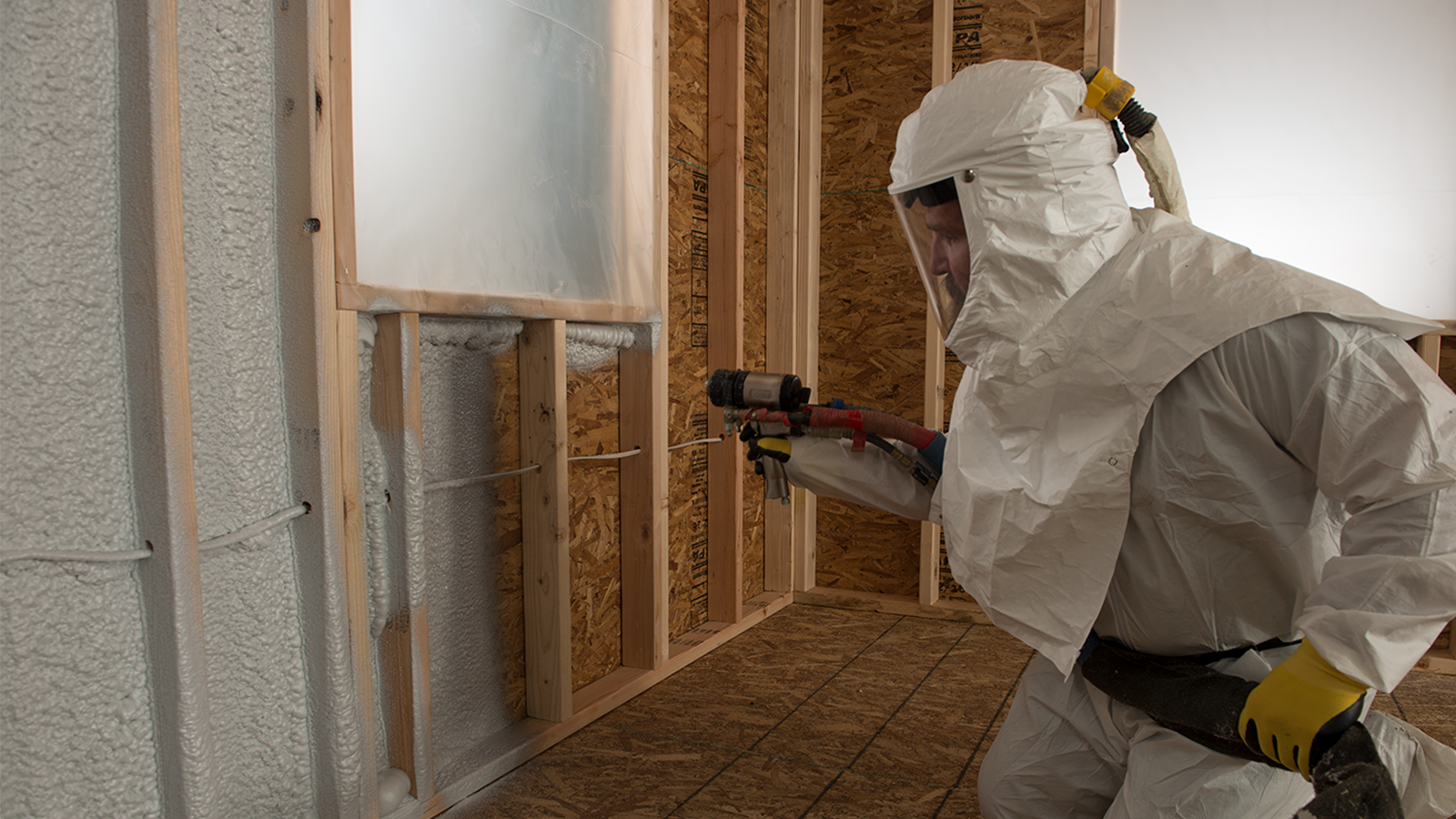
Spray polyurethane foam insulation (SPF) offers excellent thermal control, as well as advanced air and sound control, for residential and commercial applications. Spray foam can be used in a variety of places including wall cavities, attics or even as a continuous exterior insulation solution, and completely covers gaps and voids, making it especially useful in hard-to-insulate areas where installing traditional fiberglass insulation would be difficult.
There are two types of spray foam – open cell, like Johns Manville’s No Mix Open Cell (NMOC), and closed cell, like Johns Manville’s IV HFO. Both offer varying benefits, including cost and performance. We’ll explore the differences between open and closed cell so you can determine what is right for a specific project.
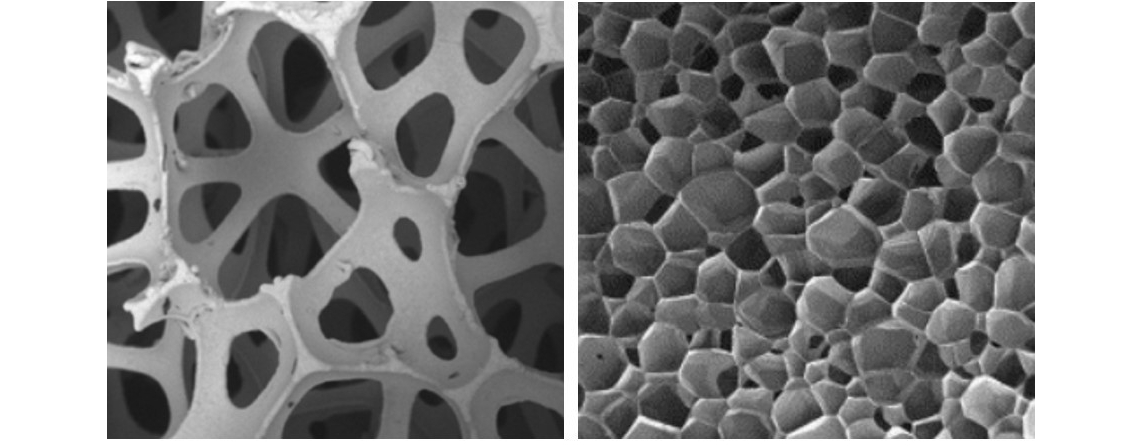
Open cell spray foam and closed cell spray foam have different physical structures that give them different thermal and acoustic performance properties. When considering these differences, understanding how foam insulations are formed is important. Foam insulation is made from two chemicals that expand rapidly after they come into contact with each other. During the expansion, bubbles are formed. In open cell spray foam, the bubbles rupture, leaving behind only the struts (the point at which two bubbles were touching each other), as shown in the picture on the left. In closed cell insulation, the bubbles don’t rupture, creating interconnected closed pockets, shown in the picture on the right.
This microscopic difference in the two products creates a dramatic difference in performance. Closed cell spray foam can have R-values greater than R-6.5 per inch. In comparison, open cell spray foam has an R-value of R-3.8 per inch. Additionally, the materials have decidedly different densities. Open cell spray foam has a density of 0.5lb/ft3 whereas the density of closed cell spray foam is 2lbs/ft3. While both materials can be used as an air barrier (open cell at 3.75” thickness or greater and closed cell at 1” thickness or greater), only closed cell spray foam creates a fully sealed system that can be used as an air and vapor barrier (at 1.5” thickness or greater). However, the porous structure of open cell spray foam allows for improved acoustics over closed cell spray foam.
While open cell spray foam tends to be less costly than closed cell foam in terms of material costs, the difference in the R-values between the two products means that any system using open cell spray foam will need more material than closed cell spray foam to achieve a given R-value. This is important to keep in mind as initial material costs may not be representative of the overall installed cost of the project.
Although you can technically use open or closed cell spray foam insulation anywhere, there is a general rule of thumb to follow when it comes to geographic location. Southern and milder climates (IECC Climate Zones 1 through 4) are most well-suited for open cell spray foam. The temperature deltas from outdoor ambient temperatures to indoor temperatures tend to be significantly smaller for structures located in the south than those located in more northern states, and exterior vapor retarders are installed in these climate zones.
For example, in southern states with milder winters and hotter summers, the difference between the outdoor and indoor temperatures is approximately 30-40°F, even at the height of summer or mid-winter. In contrast, in northern climates where winters might average 50 or more days below freezing, the temperature delta can be 40-70°F. This means northern buildings will need substantially more robust insulation to combat that temperature delta and maintain thermal efficiencies than structures in the south.
Both open and closed cell SPF will entirely fill cavities where they are installed (when done properly). Only closed cell foam creates a vapor barrier, so if an application calls for an integrated vapor barrier and insulation all in one, then closed cell SPF will provide this. For this reason, all continuous exterior insulation applications using spray foam should be closed cell.
Both closed and open cell SPF offer unique benefits that system designers and installers can rely on when designing and installing robust, thermally efficient structures. To learn more about spray foam insulation, check out Johns Manville spray foam products.