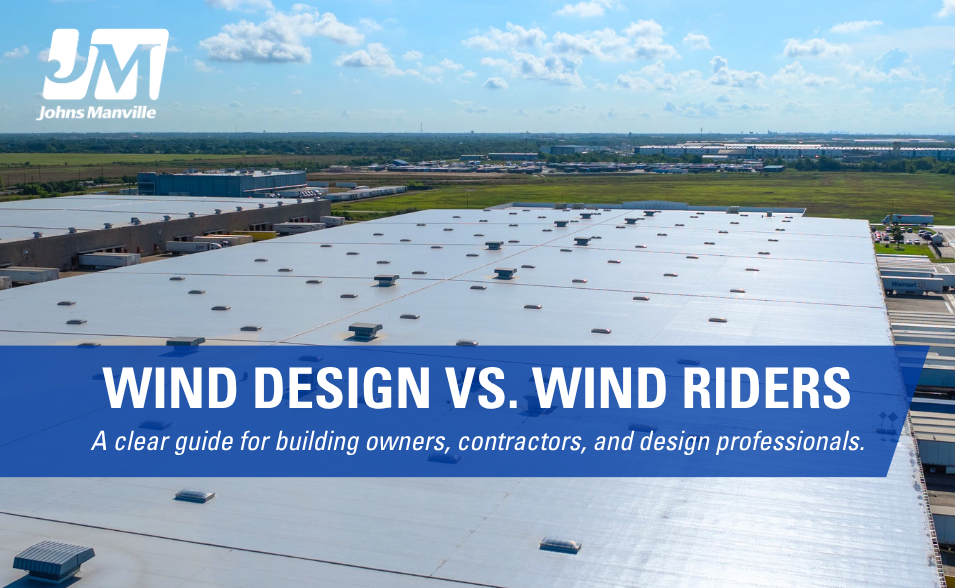
Wind Design vs. Wind Rider: What’s the Difference?
Apr. 06, 2026

A clear guide for building owners, contractors, and design professionals*
When commercial roofing projects begin, two terms often cause confusion: Wind Design and Wind Rider. They sound similar, but they serve entirely different purposes. Understanding the distinction is key to selecting the right roofing system, meeting code requirements, and ensuring wind coverage of your building through Johns Manville’s Peak Advantage® Guarantee.
This article breaks down each concept in simple, practical terms, and explains how they work together on your project.
A building-code requirement based on structural engineering
Wind design is a mandatory engineering process required by the International Building Code (IBC) and ASCE 7 calculations to determine the required wind uplift resistance. Its purpose is to ensure that the roof assembly is appropriate for the building’s location and characteristics, not to set guarantee coverage levels.
Wind design calculates wind uplift pressures using:
These calculations produce design pressures, which must be matched by a roof assembly that has been tested by an accredited agency, such as FM Global® or UL®.
Just because a project is in a 100-mph wind zone does not mean the roof must carry a 100-mph wind rider.
The 100-mph figure on ASCE 7 maps is only one variable in a complex engineering formula. The building code requires the roofing system to meet the calculated design pressures, not to be warranted for the map’s wind speed. The manufacturer is not required to issue a guarantee for that map value. JM guarantees systems based on the project specifications which should outline any enhanced wind coverage requirements.
Wind Design = Engineering and code compliance.
It ensures the roof system can resist local environmental forces, but it does not dictate the wind-speed coverage contained in a JM Guarantee wind rider.
Part of a JM Peak Advantage® Guarantee
A wind rider is an optional enhancement added to a JM Peak Advantage® Guarantee. It increases the wind-speed coverage beyond the standard guarantee language.
Under the standard JM Peak Advantage® Guarantee, roofing systems are designed and tested to withstand wind events up to 55 mph (3-second gust), a wind level classified on the Beaufort Scale as “Strong Gale Force Wind.”
Manufacturers across the roofing industry typically offer wind coverage that is below local code requirements to protect against common wind events.
A wind rider is used when an owner or project requires coverage for wind speeds higher than the manufacturer’s standard. To determine what level of rider is possible, JM requires detailed project information, including:
All these elements allow JM technical specialists to calculate uplift pressures and determine whether the requested wind rider can be supported by a tested, warrantable assembly.
If JM determines the requested rider cannot be met using the proposed system, JM will suggest enhanced attachment rates or alternative system recommendations needed that the owner must install in order for JM to issue higher wind protection levels.
Wind Rider = Extra wind protection within your JM Peak Advantage® Guarantee.
It is optional, and it is not governed by building code. It is governed by the guarantee and by the uplift performance of tested assemblies. Manufacturers reserve the right to require additional system requirements and fastening enhancements beyond established code testing to limit their liability.
Although they overlap in topic, they serve very different purposes:
| Topic | Wind Rider | Wind Design |
| Purpose | Increase guarantee wind-speed coverage | Meet building code requirements |
| Driven By | JM Guarantee standards & system testing | IBC requirements & ASCE 7 engineering calculations |
| Required? | Optional | Mandatory |
| Based On | Uplift test performance of JM assemblies | Calculated design pressures |
| Determines | What wind speed your guarantee covers | What roofing systems are code-compliant |
A building always needs wind design to comply with code.
A building may or may not need a wind rider, depending on owner expectations or risk tolerance.
JM is a roofing materials manufacturer, not a structural engineering firm. The information provided helps clarify concepts, but wind design calculations must be performed by a licensed design professional to meet code requirements.
For questions about wind riders, system options, or Peak Advantage® Guarantee requirements, contact JM Technical Services at 800-922-5922 (Option 3).
*THIS MATERIAL IS PROVIDED FOR EDUCATIONAL PURPOSES ONLY. JM IS A ROOFING MATERIALS MANUFACTURER, NOT A STRUCTURAL ENGINEERING FIRM. THE INFORMATION PROVIDED IS TO ASSIST IN CLARIFYING CONCEPTS, BUT ALL WIND DESIGN CALCULATIONS MUST BE PERFORMED AND/OR APPROVED BY A LICENSED DESIGN PROFESSIONAL.