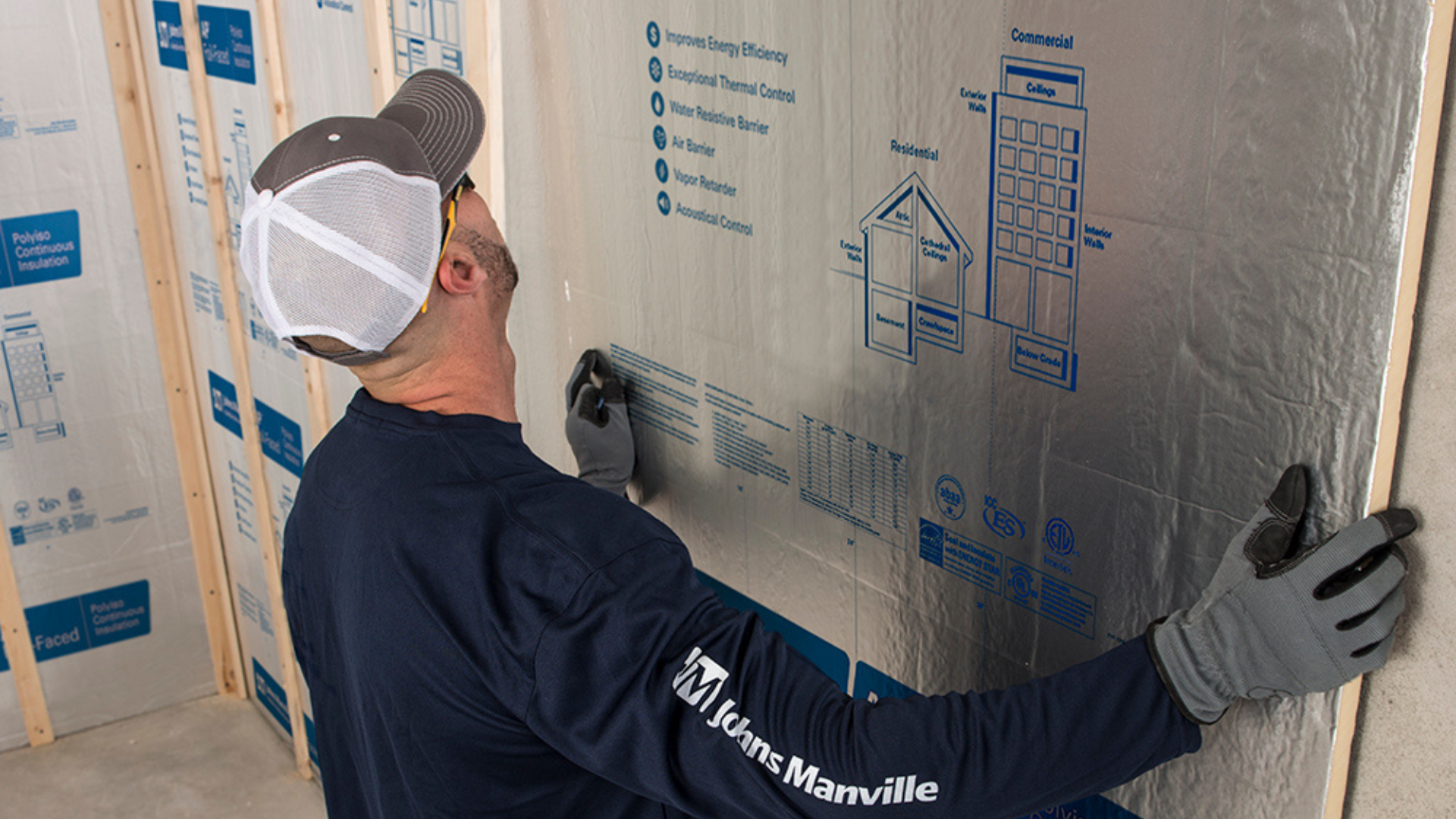
Johns Manville makes three different continuous insulation board products. They are made of a uniform closed-cell polyisocyanurate foam core and provide one of the highest R-values per inch of any rigid insulation. So, which do you choose?
This blog discusses their similarities, and breaks down the differences, so you can choose whichever one is best for your job.
Polyiso foam board basics
Continuous insulation boards provide a layer of insulation to reduce thermal bridging and improve energy efficiency. By doing this, a building’s utility costs go down, while occupant comfort goes up.
Inch for inch, polyiso boards have one of the highest energy efficiencies, so you can get a higher R-value with a thinner product than fiberglass insulation. They’re a good choice if you don’t have space for a 6” fiberglass batt, for example, but need the R-value it would provide.
JM’s polyiso continuous insulation products are AP™ Foil, AP™ Foil25 and CI Max®. All three qualify as a Class I vapor retarder, and all of them meet the requirements for ASTM E84 testing for flame spread and smoke development.
AP Foil
This is a great product for almost anywhere that continuous insulation is desired. It provides moisture, heat and air control, and eliminates major thermal bridges that cause heat loss. It is resistant to heat transfer and has a water-resistive barrier. A rigid insulation, AP Foil is noncorrosive, so it doesn’t accelerate corrosion of pipes, wiring or metal studs.
Lightweight and easy to handle, AP Foil can be cut with a utility knife or saw. It’s available in vales R-2.9 to R-28, ranging in thickness from 0.5 to 4.5 inches.
AP Foil25
For applications that are specified to a higher compressive strength, use AP Foil25. It can be preferrable for below grade and commercial applications that require compressive strength. Like standard AP Foil, AP Foil25 can also be used in NFPA 285 approved assemblies, making it a great choice for larger commercial projects that call for this fire performance requirement.
AP Foil25 comes in values from R-10 to R-19, with thicknesses ranging from 1.65 to 3 inches, depending on R-value.
CI Max
This product shines in exposed interior applications. It’s a great choice of continuous insulation for buildings like warehouses, data centers and some residential applications, particularly basements. It is resistant to heat transfer and offers R-values up to R-26.
Lightweight and easy to handle, CI Max can be cut with a utility knife or saw. It is NFPA 286 approved for interior fire performance. Depending on its R-value, CI Max ranges in thickness from 0.5 to 4 inches.
Ultimately, continuous insulation products offer a variety of benefits and overall contribute to a better building. Not only is this good for occupant comfort and utility bill savings, but a strong building envelope is good for the environment too. Whether you’re looking for above or below grade, indoor or outdoor application, JM has a continuous insulation product for your project.