Choosing Insulation for Data Center Chilled Water: Understanding Performance Differences Between Fiberglass and Elastomeric Rubber

Data centers operate continuously, with chilled water systems exposed to round the clock thermal loads and shifting humidity. Because these conditions elevate the risk of heat gain, condensation, and installation challenges, engineers often compare multiple insulation types, including fiberglass and elastomeric rubber.

Recent modeling shows that certain fiberglass systems – specifically Johns Manville Micro-Lok® HP – exhibit measurable differences in energy performance, vapor control, and installation efficiency, particularly on large diameter piping common in data center infrastructure.

The stakes: energy use and condensation control

Based on 8,320 annual operating hours of data center cooling, even small reductions in heat gain add up. Under identical modeled conditions* (80°F ambient, 45°F fluid, aluminum jacketing, 450% COP), Micro-Lok® HP showed lower annual heat gain at the same thickness compared to elastomeric insulation – 182,800 vs. 213,100 BTU/yr/ft at 1.5" – resulting in a projected energy cost difference of roughly $47 per 100 ft per year. Scaled across long chilled water mains, these price differences become meaningful.

Condensation control is equally critical, as moisture can lead to corrosion, saturation, and Indoor Air Quality (IAQ) issues. At 80% RH*, the modeling indicated that Micro-Lok HP met the no condensation threshold at 2.0", while elastomeric required approximately 2.5". In higher humidity environments (e.g., 90% RH), the required thickness gap widens further – about 5.5" for fiberglass vs.  approximately 6.5" for elastomeric.* Fewer inches and layers can reduce seams and simplify installation.


Vapor retarder performance: achieving ≤ 0.02 perms

For sub ambient lines, standard practice targets a system permeance of ≤ 0.02 perms. Elastomeric typically falls around 0.05 perms, with sheets around 0.08 perms, which means they generally require a separate field applied vapor retarder to meet the target.

Micro-Lok HP, however, includes factory applied All-Service Jacketing (ASJ) designed to meet this requirement, reducing installation steps and minimizing field dependent variables.


Large diameter realities: 18"-24" mains

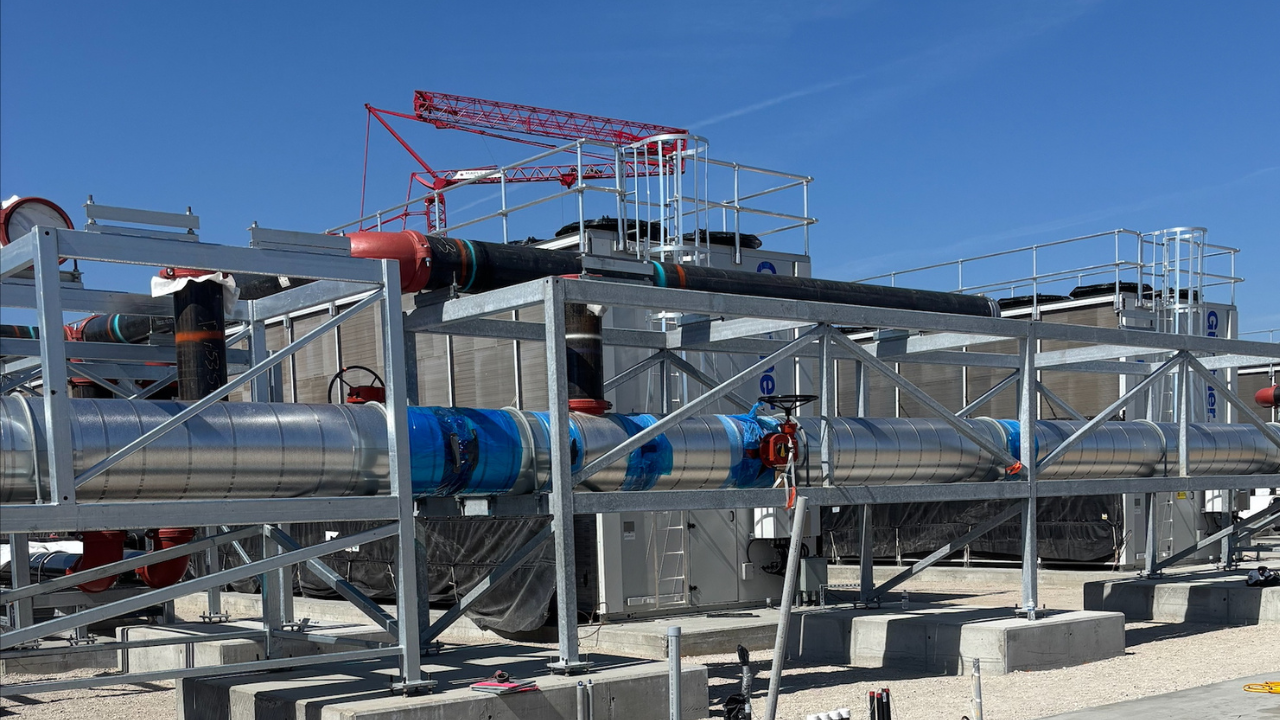
Many chilled water applications in data centers use large diameter pipe. Material format can significantly impact installation labor:

  • Micro-Lok HP is available in preformed pipe sections up to 24" NPS, in thicknesses up to 4.5", enabling direct placement and banding.
  • Elastomeric typically tops out around 10" NPS, requiring installers to wrap sheet material in multiple layers for larger pipes.

More layers mean more seams, and therefore and more opportunities for thermal or vapor barrier inconsistencies.

Modeled scenarios: summary of results

1.5" Thickness, 80%RH*

Properties

Micro-Lok HP

Elastomeric Rubber

Thickness 1.5" pipe section Elastomeric Rubber
Heat Gain (BTU/yr/ft) 182,800 1.5" sheet
Energy Cost ($/100 ft/yr) $286.00 213,100
Energy Savings ($/100 ft/yr) $47.00 less $333.00
80% RH, insulation thickness sufficient to prevent condensation No (2") No (2.5")
2.0" Thickness, 80% RH*

Properties

Micro-Lok HP

Elastomeric Rubber

Thickness 2.0"  pipe section 2.0"  sheet
Heat Gain (BTU/yr/ft) 144,100 169,300
Energy Cost ($/100 ft/yr) $225.00 $265.00
Energy Savings ($/100 ft/yr) $40.00  
80% RH, insulation thickness sufficient to prevent condensation Yes No (2.5")
Thickness to stop surface condensation, 90% RH*

Properties

Micro-Lok HP

Elastomeric Rubber

Thickness 5.5" 5.5"
Heat Gain (BTU/yr/ft) 68,250 80,870
Energy Cost ($/100 ft/yr) $107.00 $126.00
Energy Savings ($/100 ft/yr) $19.00  
80% RH, insulation thickness sufficient to prevent condensation Yes - 2 layers, pipe sections (3.5" + 2") No – 6.5”, 4 layers, sheet (2" + 2" + 1.5" +1")

Total installed cost and risk considerations

When elastomeric systems require additional vapor retarder layers or multiple wraps on large pipe, the number of installation hours increases. Additionally, each field applied seam or jacket represents a potential failure point. Things like tape adhesion, surface prep, and pinholes all introduce moisture risks in high humidity environments.

Pre jacketed fiberglass reduces these variables and can help improve schedule predictability while supporting long term system performance.

All in all, for mission critical chilled water systems, modeled comparisons show that Micro-Lok HP can deliver meaningful differences in energy use, condensation resistance, and installation efficiency, especially on large diameter piping common in data center plants. These differences may support reliability and operational cost goals where thermal performance is tightly scrutinized.

*The heat loss and energy cost calculations referenced above were determined using the North American Insulation Manufacturers Associations (NAIMA) 3E Plus insulation thickness software program. The calculations are presented in good faith using the following design conditions:

  • 18" NPS Pipe Size
  • Ambient Temperature: 80°F, no wind
  • Process Temperature: 45°F
  • 0.016" aluminum jacketing (0.1 emittance)
  • Electric chillers, 450% COP, $0.24/kWh, 8,320 hrs./yr operation