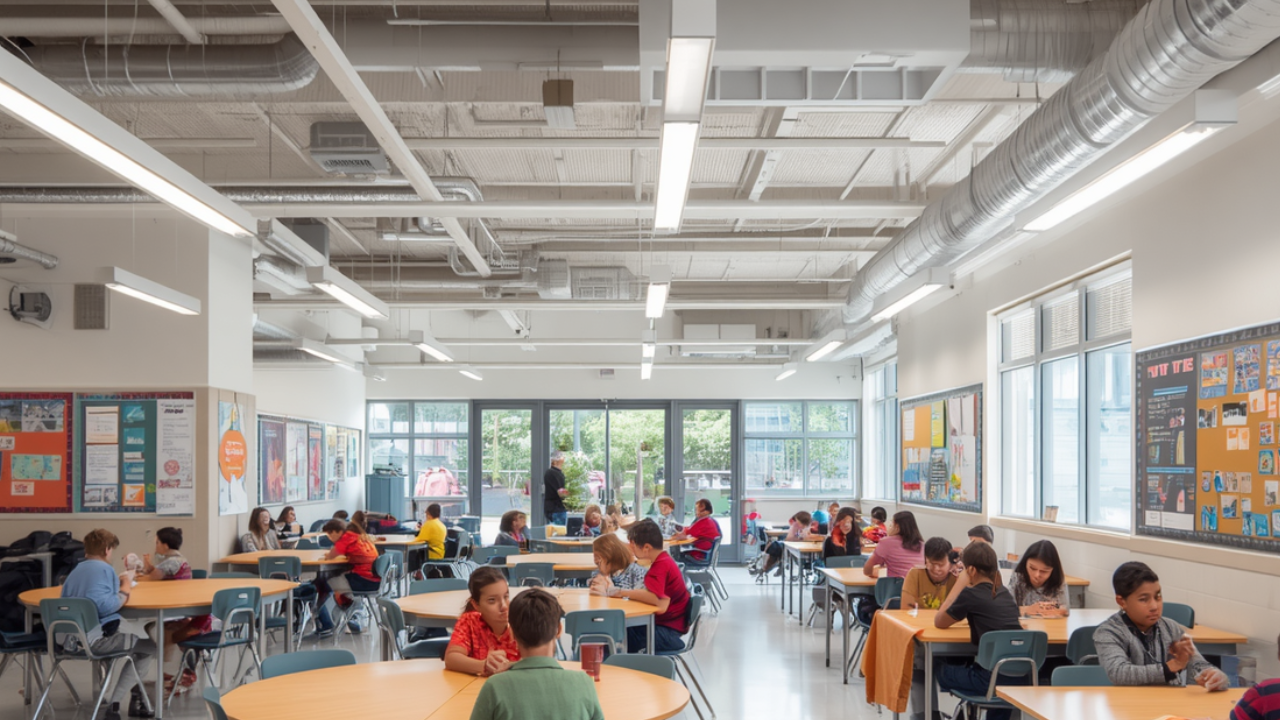
Modern HVAC systems in schools have one main purpose: to create a comfortable, healthy environment for productive learning. That can be compromised, however, by the air distribution ductwork. Fortunately, fiberglass insulation products, either duct liner or duct board, can make a big difference. They can help keep air distribution quiet, comfortable and efficient.
There are a variety of issues that HVAC insulation can address in schools, from acoustics to air quality to energy efficiency. And fortunately, fiberglass products are adept at tackling it all.
Classroom acoustics
Studies have pointed out the distinct differences in ways that adults and children hear, particularly that children demonstrate a lower comprehension than adults when background noise is present. One of fiberglass duct insulation’s best qualities is its ability to reduce noise from HVAC equipment and air movement, making it a great option for school use.
Designing and building quiet and vibration-free buildings is the mission of ASHRAE’s Sound and Vibration technical committee. This committee recognizes the use of fiberglass as an effective sound-absorbing material in HVAC systems to reduce noise.
If you’ve ever been in a building that gets markedly quieter when the furnace or AC turns off, you know how distracting it can be when it toggles on and off. Insulation absorbs and blocks sound waves in an HVAC system, reducing overall noise transmission. This in turn creates quieter environments with less distracting background noise, which helps kids learn.
Thermal control
Fiberglass insulation in air handling systems also provides thermal benefits, preventing condensation on the outside of sheet metal ducts. When a duct runs through warm, humid conditioned spaces, and the air inside the duct is cold enough, condensation will form on a bare duct.
The build-up of condensation can lead to mold, structural damage and reduced HVAC efficiency. Moisture on ducts provides a breeding ground for mold and mildew, which can then impact indoor air quality and potentially cause health issues. Condensation can also cause corrosion, rusting and deterioration of the ductwork. This can lead to air leaks or reduced flow and may require costly maintenance. By lining ducts, these issues can be avoided.
Indoor air quality
Mold can grow on just about any surface, including bare sheet metal, if nutrients and moisture are present. When properly installed and maintained, fiberglass ducts and liners will not support microbial growth. Without the threat of mold and mildew, air quality is improved.
Coated fiberglass insulation products offer additional protection. Johns Manville Linacoustic® RC and RC-IG products have our proprietary Permacote® coating, as does our Spiracoustic Plus® round duct liner system. Formulated with an immobilized, EPA-registered protective agent, Permacote provides a durable surface and added product protection against microbial growth.
Energy efficiency
Fiberglass insulation plays a key role in delivering conditioned air at the desired temperature, eliminating the need to overheat or overcool the air. Consider this example: For a bare sheet metal duct running through an 80°F plenum space, the temperature of air cooled to 55°F can rise almost 10°F every 100 feet. However, if the duct is lined or fabricated with 1” of fiberglass, the temperature rises less than 2°F.
This means an HVAC system with insulated ducts will not have to run as often or work as hard, reducing energy bills and extending the life of the system. In environments such as schools where funding is often tight, every penny counts.
Fiberglass health and safety
Fiberglass is safe. It is one of the most tested and studied products in the insulation market. Overwhelming evidence shows there is no cancer risk by inhalation of fiberglass insulation products, and exposures are very low. Insulation glass fibers are not classified as carcinogens.
Additionally, rigorous testing proves that an airstream does not cause fiber shedding. ASTM C1071 standards ensure that products can withstand high-velocity air streams without degrading, so there’s no worry about fibers eroding and getting into the air stream. Fiberglass duct liners are tested to withstand air velocities of up to 15,000 feet per minute, equivalent to a Category 5 hurricane. In comparison, HVAC systems typically operate at velocities ranging from 400 to 3,000 feet per minute.
Cost effectiveness and value engineering
Choosing the right fiberglass air handling materials from Johns Manville can result in measurable cost savings, and JM has options.
For example, duct board can easily be substituted for lined sheet metal, which reduces costs but maintains performance. Our line of Spiracoustic Plus® products for round ducts are a cost-effective alternative to perforated metal double-wall round ducts. They provide consistent, predictable performance while helping to keep labor costs under control.
In addition to improving acoustics, using fiberglass insulation products on a school’s HVAC system can do so much more, including improving air quality and energy efficiency. Fiberglass is a safe and effective product that is widely used and readily accepted as a top choice for HVAC insulation.