
Cross-Flo Jacketing Resources
Revolutionize your insulation systems with Cross-Flo® Jacketing - Johns Manville’s latest advancement in metal jacketing engineered for superior performance, durability, and aesthetics.
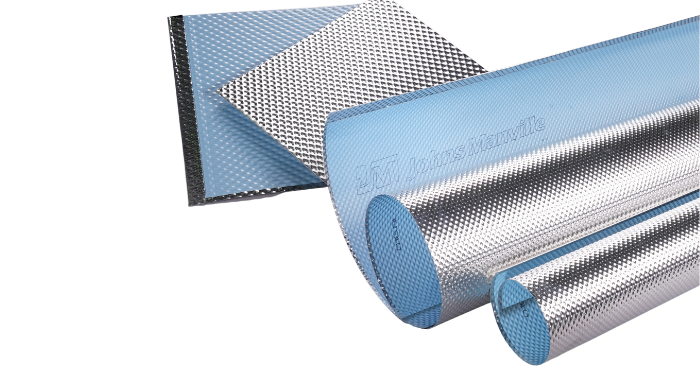
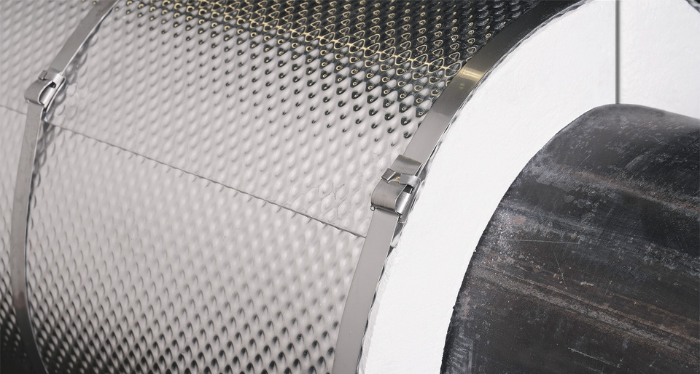
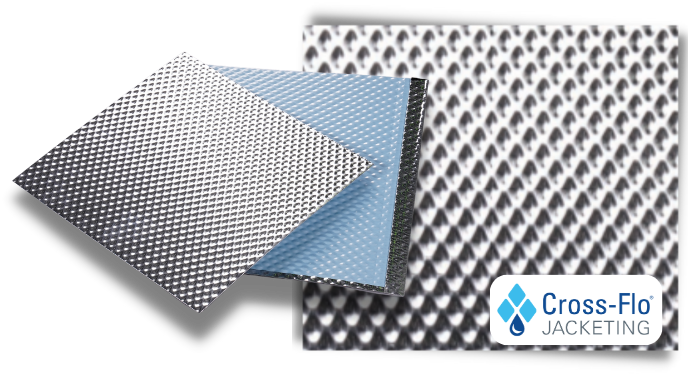
Designed for industrial applications where protection and performance are non-negotiable, Cross-Flo Jacketing features an embossed pattern that promotes cross-directional flow, reduces corrosion under insulation (CUI), and simplifies installation.
This innovative design not only improves long-term system integrity but also delivers a clean, modern appearance that sets your projects apart.
Documents
CUI is a huge concern for engineers and specifiers in the industrial sector. Despite insulation systems being designed to deter water ingress, infiltration is almost inevitable. Even though JM’s industrial products are water resistant or hydrophobic (and the rigid insulations also have a corrosion inhibitor), impurities present in water can interact with metal piping and lead to corrosion. CUI is difficult to detect, which can lead to catastrophic consequences.
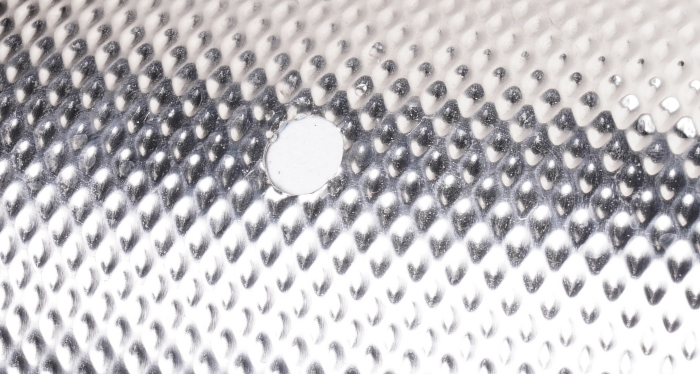
Cross-Flo Jacketing and its embossed pattern engineered to promote cross-directional flow (CDF), provides a path for liquid that may enter the insulation system to reach the low point and exit the jacketing through a weep hole or drainage port. It reduces the risk of CUI by minimizing the time water remains in the system
When does CUI occur?
• During construction and temporary shutdowns
• Through improper installation or damage during normal operation
• With exposure to water from rain, storms or improper storage
What's the Impact?
• Refineries can face lengthy downtimes
• Costly repairs
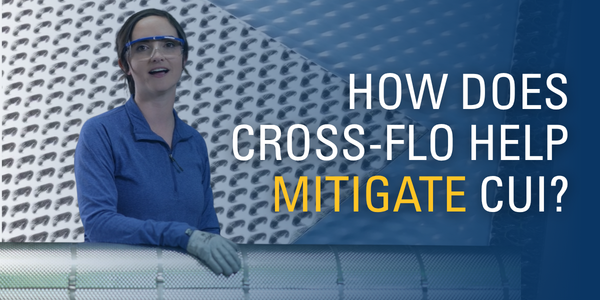
From installation ease to durability, Cross-Flo has a variety of features that make it ideal of any metal jacketing application. Request a sample today.
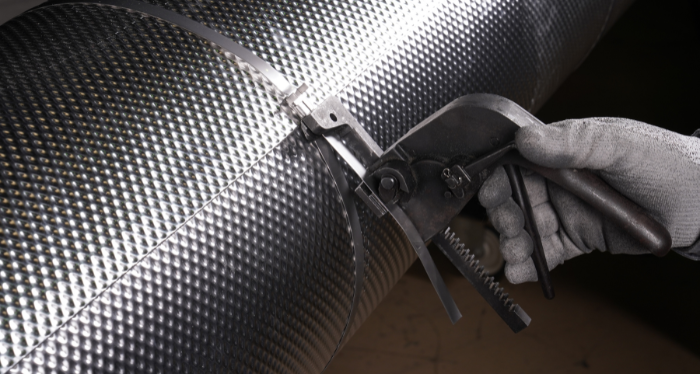
Cross-Flo Jacketing vs.
Smooth Aluminum Jacketing
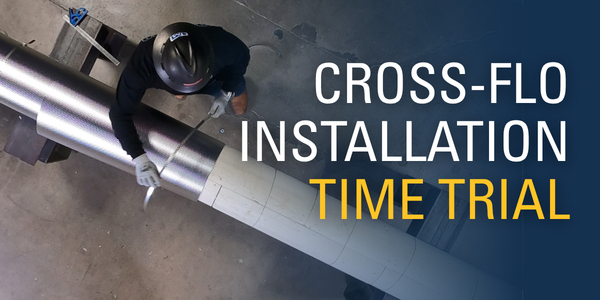
Cross-Flo Jacketing is a great way to fight corrosion under insulation. If you’re wondering how it stacks up when it comes to installation time, watch for yourself in this time trial video.
We compare Cross-Flo and smooth aluminum jacketing side-by-side.

TEST #2
Drainage
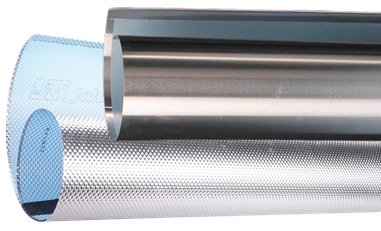
To test the efficacy of Cross-Flo Jacketing, JM’s team conducted a small-scale simulation testing during which 100mL of water was allowed to drain through representative insulated pipe sections jacketed with Cross-Flo, smooth, and stucco embossed patterns. Tested insulation types included calcium silicate, perlite, mineral wool, and aerogel.
80% FASTER
Cross-Flo Jacketing drained 80% faster than smooth jacketing.
27 SECONDS
Smooth jacketing held water in the system for 15 minutes, while Cross-Flo drained the water in just 27 seconds.
TEST #3
Flexural Strength
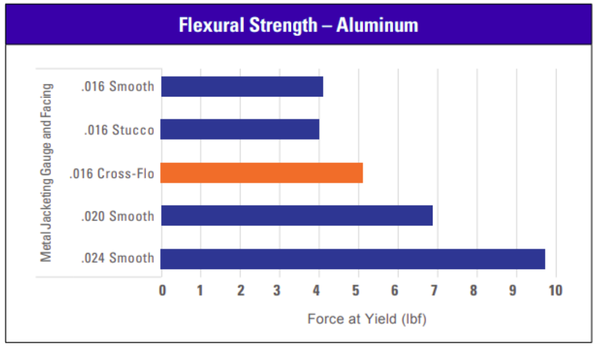
Cross-Flo also exhibits increased flexural strength compared to standard metal jacketing. In fact,it exhibits an approximate 30% improvement in flexural strength against .016 smooth and stucco embossed jacketing.
This increased rigidity, while not negatively affecting handleability or installation, helps ensure the protection of the insulation beneath Cross-Flo, whether that be due to foul weather, accidental damage or abuse incurred by everyday activities on a worksite.
- FAQ
- Videos
In systems at risk of CUI, JM strongly recommends that Cross-Flo jacketing is installed in conjunction with weep holes, to provide anegress point for moisture. JM’s internal testing was completed with ¾” circular weep holes; specific system configurations should be designed by a qualified engineer.
Although hydrophobic materials themselves repel water, all insulation types have seams, and water may ingress through system damage over time. Additionally, water-repellent treatments may be susceptible to degradation over time, due to burn-off or other factors. Regardless of the type of insulation used, the longer water is allowed to remain in the system, the higher the likelihood it will reach the metal surface of the pipe and result in CUI.
Where CUI is not a concern, Cross-Flo jacketing can be used without a weep hole for aesthetic purposes.
Yes, Cross-Flo jacketing comes standard with the same 3mm polyfilm moisture barrier present on all JM metal jacketing products.
Cross-Flo jacketing is effective over all insulation types, rigid and non-rigid.

In this test, we assess the strength of XSPECT ISOfoam APF board and Cross-Flo Metal Jacketing. The JM team drops a hammer from 4ft. to evaluate the durability of these products.

In this hands-on demonstration, Sr. Product Manager Jack Bittner shows why contractors trust Cross-Flo for efficiency and long-term performance. Check out the benefits in action
In this time trial video, we compare Cross-Flo and smooth aluminum jacketing side-by-side.

Learn about Polyfilm Moisture Barrier (PFMB) and why it is an effective and low-cost way to reduce the risk of corrosion of metal jacketing.
Maintenance costs related to CUI can be quite costly. Learn about how Cross-Flo Jacketing is specifically designed to allow unwanted water to escape an insulation system.